

What Do We Call Organisms That Eat Both Plants And Animals?

An omnivore () is an brute that has the power to eat and survive on both plant and animate being affair.[iii] Obtaining energy and nutrients from found and fauna thing, omnivores digest carbohydrates, protein, fat, and fiber, and metabolize the nutrients and energy of the sources absorbed.[iv] Often, they have the ability to incorporate nutrient sources such as algae, fungi, and bacteria into their nutrition.[v] [vi] [7]
Omnivores come from diverse backgrounds that oftentimes independently evolved sophisticated consumption capabilities. For instance, dogs evolved from primarily carnivorous organisms (Carnivora) while pigs evolved from primarily herbivorous organisms (Artiodactyla).[eight] [ix] [10] Despite this, physical characteristics such as tooth morphology may be reliable indicators of diet in mammals, with such morphological adaptation having been observed in bears.[eleven] [12]
The variety of different animals that are classified every bit omnivores tin be placed into further sub-categories depending on their feeding behaviors. Frugivores include maned wolves and orangutans;[13] [fourteen] insectivores include swallows and pinkish fairy armadillos;[xv] [16] granivores include big ground finches and mice.
All of these animals are omnivores, yet notwithstanding fall into special niches in terms of feeding behavior and preferred foods. Existence omnivores gives these animals more nutrient security in stressful times or makes possible living in less consistent environments.[17]
Etymology and definitions [edit]
The discussion omnivore derives from Latin omnis 'all' and vora, from vorare 'to swallow or devour', having been coined by the French and subsequently adopted past the English in the 1800s.[18] Traditionally the definition for omnivory was entirely behavioral by means of but "including both animal and vegetable tissue in the diet.[19]" In more recent times, with the advent of avant-garde technological capabilities in fields similar gastroenterology, biologists have formulated a standardized variation of omnivore used for labeling a species' actual ability to obtain energy and nutrients from materials.[20] [21] This has subsequently conditioned two context specific definitions.
- Behavioral: This definition is used to specify if a species or individual is actively consuming both plant and animal materials.[21] [22] [23] [24] (e.g. "vegans do not participate in the omnivore based nutrition.") In the fields of nutrition, folklore and psychology the terms "omnivore" & "omnivory" is oft used to distinguish prototypical highly diverse human being nutrition patterns from restricted nutrition patterns that exclude major categories of nutrient.[25] [26] [27] [28] [29]
- Physiological: This definition is often used in academia to specify species that take the capability to obtain energy and nutrients from both plant and animal matter.[xxx] [ page needed ] [six] [20] [31] (east.thou. "humans are omnivores due to their capability to obtain energy and nutrients from both establish and animal materials.")
The taxonomic utility of omnivore'due south traditional and behavioral definition is limited, since the diet, beliefs, and phylogeny of one omnivorous species might be very different from that of some other: for example, an omnivorous pig digging for roots and scavenging for fruit and carrion is taxonomically and ecologically quite distinct from an omnivorous chameleon that eats leaves and insects. The term "omnivory" is also not e'er comprehensive because it does not deal with mineral foods such as salt licks and the consumption of plant and creature material for medical purposes which would non otherwise exist consumed (i.due east. zoopharmacognosy) within non-omnivores.
Classification, contradictions and difficulties [edit]
Though Carnivora is a taxon for species classification, no such equivalent exists for omnivores, as omnivores are widespread beyond multiple taxonomic clades. The Carnivora order does not include all carnivorous species, and non all species within the Carnivora taxon are carnivorous. (The members of Carnivora are formally referred as carnivorans.)[32] It is common to find physiological carnivores consuming materials from plants or physiological herbivores consuming material from animals, east.g. felines eating grass and deer eating birds.[33] [34] From a behavioral aspect, this would make them omnivores, simply from the physiological standpoint, this may exist due to zoopharmacognosy. Physiologically, animals must exist able to obtain both energy and nutrients from plant and animal materials to exist considered omnivorous. Thus, such animals are still able to be classified as carnivores and herbivores when they are just obtaining nutrients from materials originating from sources that exercise non seemingly complement their classification. For instance, it is well documented that animals such equally giraffes, camels, and cattle volition gnaw on bones, preferably dry bones, for particular minerals and nutrients.[35] Felines, which are usually regarded as obligate carnivores, occasionally eat grass to regurgitate indigestibles (e.g. hair, basic), help with hemoglobin product, and equally a laxative.[36]
Occasionally, it is found that animals historically classified as carnivorous may deliberately swallow plant cloth. For example, in 2013, it was considered that American alligators (Alligator mississippiensis) may be physiologically omnivorous once investigations had been conducted on why they occasionally eat fruits. It was suggested that alligators probably ate fruits both accidentally and deliberately.[37]
"Life-history omnivores" is a specialized classification given to organisms that change their eating habits during their life bicycle.[38] Some species, such every bit grazing waterfowl similar geese, are known to swallow mainly animal tissue at one stage of their lives, merely establish matter at another.[39] The aforementioned is true for many insects, such every bit beetles in the family Meloidae,[40] which begin by eating beast tissue as larvae, but alter to eating establish matter after they mature. Likewise, many musquito species in early on life eat plants or contrasted detritus, only as they mature, males continue to eat constitute matter and nectar whereas the females (such as those of Anopheles, Aedes and Culex) also eat blood to reproduce finer.[41]
Omnivorous species [edit]
General [edit]
Although cases exist of herbivores eating meat and carnivores eating plant matter, the classification "omnivore" refers to the adaptation and chief food source of the species in general, so these exceptions practise not make either individual animals or the species as a whole omnivorous. For the concept of "omnivore" to be regarded every bit a scientific classification, some clear set of measurable and relevant criteria would need to be considered to differentiate between an "omnivore" and other categories, e.g. faunivore, folivore, and scavenger.[42] Some researchers argue that evolution of whatsoever species from herbivory to carnivory or carnivory to herbivory would be rare except via an intermediate phase of omnivory.[43]
Omnivorous mammals [edit]
Various mammals are omnivorous in the wild, such as species of hominids, pigs,[44] badgers, bears, coatis, civets, hedgehogs, opossums, skunks, sloths, squirrels,[45] raccoons, chipmunks,[46] mice,[47] hamsters and rats.[48] [7] [49] [50]
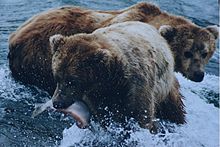
Most comport species are omnivores
Most bear species are omnivores,[51] just individual diets can range from about exclusively herbivorous (hypocarnivore) to almost exclusively cannibal (hypercarnivore), depending on what food sources are bachelor locally and seasonally. Polar bears are classified as carnivores, both taxonomically (they are in the order Carnivora), and behaviorally (they subsist on a largely carnivorous diet). Depending on the species of bear, there is generally a preference for i grade of food, as plants and animals are digested differently. Canines including wolves, dogs, dingoes, and coyotes swallow some plant matter, merely they have a general preference and are evolutionarily geared towards meat.[52] Nevertheless, the maned wolf is a canid whose nutrition is naturally 50% plant affair.
Like virtually arboreal species, squirrels are primarily granivores, subsisting on nuts and seeds.[53] However, like nearly all mammals, squirrels avidly consume some animal food when it becomes available. For example, the American eastern grey squirrel has been introduced to parts of Britain, continental Europe and South Africa. Its effect on populations of nesting birds is ofttimes serious because of consumption of eggs and nestlings.[54] [55]
Other species [edit]
Various birds are omnivorous, with diets varying from berries and nectar to insects, worms, fish, and pocket-sized rodents. Examples include cranes, cassowaries, chickens, crows[56] and related corvids, kea, rallidae, and rheas. In improver, some lizards (such as Galapagos Lava Lizard), turtles, fish (such equally piranhas and catfish), and invertebrates are omnivorous.
Quite often, mainly herbivorous creatures will eagerly swallow small quantities of animal nutrient when it becomes available. Although this is trivial most of the time, omnivorous or herbivorous birds, such equally sparrows, often will feed their chicks insects while food is most needed for growth.[57] On close inspection it appears that nectar-feeding birds such as sunbirds rely on the ants and other insects that they find in flowers, not for a richer supply of poly peptide, but for essential nutrients such equally cobalt/vitamin b12 that are absent from nectar. Similarly, monkeys of many species consume maggoty fruit, sometimes in clear preference to audio fruit.[58] When to refer to such animals every bit omnivorous, or otherwise, is a question of context and emphasis, rather than of definition.
See also [edit]
- Consumer-resources systems
- Evolution (biology)
- Food chain
- Food free energy
- Ingestion
- Listing of diets
- Mesocarnivore
- Productivity (ecology)
- List of feeding behaviours
References [edit]
- ^ Beasley, DeAnna; Koltz, Amanda; Lambert, Joanna; Fierer, Noah; Dunn, Rob (29 July 2015). "The Evolution of Tummy Acidity and Its Relevance to the Human being Microbiome". PLOS ONE. 10 (vii): e0134116. Bibcode:2015PLoSO..1034116B. doi:10.1371/periodical.pone.0134116. PMC4519257. PMID 26222383.
- ^ Dewey, T. & Bhagat, S. (2002). "Canis lupus familiaris". Animal Diversity Web. Retrieved iii April 2016.
- ^ Brooker RJ (2008). Biology . McGraw-Hill. p. 1326. ISBN978-0072956207.
- ^ Pond G, Ullrey DE, Baer CK (2018). Encyclopedia of Fauna Science - (Two-Volume Set up). McGraw-Colina. p. 1350. ISBN978-0072956207.
- ^ Bradford, Alina (25 Jan 2016). "Reference: Omnivores: Facts About Flexible Eaters". Livescience. Retrieved 2 Apr 2016.
- ^ a b "Omnivore". National Geographic Pedagogy. National Geographic Society. 21 January 2011. Retrieved 4 October 2012.
- ^ a b McArdle, John. "Humans are Omnivores". Vegetarian Resource Group. Retrieved half dozen October 2013.
- ^ "Why Your Dog'southward Pedigree Goes Back 40 One thousand thousand Years". About.com Education . Retrieved ii April 2016.
- ^ "Evolutionary History of Pigs – Domesticating Wilbur". blogs.lt.vt.edu . Retrieved 2 April 2016.
- ^ "Order Cetartiodactyla - Fifty-fifty-toed ungulates (and whales)". www.ultimateungulate.com . Retrieved ii April 2016.
- ^ Evans, Alistair R.; Pineda-Munoz, Silvia (2018), Croft, Darin A.; Su, Denise F.; Simpson, Scott W. (eds.), "Inferring Mammal Dietary Ecology from Dental Morphology", Methods in Paleoecology: Reconstructing Cenozoic Terrestrial Environments and Ecological Communities, Vertebrate Paleobiology and Paleoanthropology, Springer International Publishing, pp. 37–51, doi:ten.1007/978-three-319-94265-0_4, ISBN978-3-319-94265-0
- ^ Sacco, Tyson; Valkenburgh, Blaire Van (2004). "Ecomorphological indicators of feeding behaviour in the bears (Carnivora: Ursidae)". Journal of Zoology. 263 (1): 41–54. doi:10.1017/S0952836904004856. ISSN 1469-7998.
- ^ Motta-Junior, J. C.; Talamoni, Southward. A.; Lombardi, J. A.; Simokomaki, One thousand. (1 October 1996). "Diet of the maned wolf, Chrysocyon brachyurus, in fundamental Brazil". Journal of Zoology. 240 (2): 277–284. doi:10.1111/j.1469-7998.1996.tb05284.x. ISSN 1469-7998.
- ^ Galdikas, Biruté M. F. (1 February 1988). "Orangutan diet, range, and activity at Tanjung Puting, Primal Borneo". International Journal of Primatology. 9 (1): 1–35. doi:10.1007/BF02740195. ISSN 0164-0291. S2CID 40513842.
- ^ McCarty, John P.; Winkler, David Westward. (ane January 1999). "Foraging Ecology and Diet Selectivity of Tree Swallows Feeding Nestlings". The Condor. 101 (2): 246–254. doi:10.2307/1369987. JSTOR 1369987.
- ^ Superina, Mariella (1 March 2011). "Husbandry of a pink fairy armadillo (Chlamyphorus truncatus): case study of a ambiguous and little known species in captivity". Zoo Biological science. 30 (two): 225–231. doi:10.1002/zoo.20334. ISSN 1098-2361. PMID 20648566.
- ^ Shute, Nancy (xx April 2012). "For Nigh Of Human History, Being An Omnivore Was No Dilemma". NPR . Retrieved iii Apr 2016.
- ^ "omnivore: definition of omnivore in Oxford dictionary (American English) (US)". www.oxforddictionaries.com . Retrieved 2 April 2016.
- ^ Collocott, T. C., ed. (1974). Chambers Dictionary of science and technology. Edinburgh: W. and R. Chambers. ISBN978-0-550-13202-iv.
- ^ a b "Omnivore - Biology-Online Dictionary". world wide web.biological science-online.org . Retrieved two April 2016.
- ^ a b "omnivore - definition of omnivore in English from the Oxford dictionary". www.oxforddictionaries.com . Retrieved ii Apr 2016.
- ^ "Definition of OMNIVORE". www.merriam-webster.com . Retrieved ii April 2016.
- ^ "omnivore Definition in the Cambridge English Dictionary". dictionary.cambridge.org . Retrieved 2 Apr 2016.
- ^ Clarys, Peter; Deliens, Tom; Huybrechts, Inge; Deriemaeker, Peter; Vanaelst, Barbara; De Keyzer, Willem; Hebbelinck, Marcel; Mullie, Patrick (24 March 2014). "Comparing of Nutritional Quality of the Vegan, Vegetarian, Semi-Vegetarian, Pesco-Vegetarian and Omnivorous Nutrition". Nutrients. six (3): 1318–1332. doi:10.3390/nu6031318. ISSN 2072-6643. PMC3967195. PMID 24667136.
- ^ Michel, Fabienne; Knaapila, Antti; Hartmann, Christina; Siegrist, Michael (1 July 2021). "A multi-national comparison of meat eaters' attitudes and expectations for burgers containing beef, pea or algae protein". Nutrient Quality and Preference. 91: 104195. doi:10.1016/j.foodqual.2021.104195. ISSN 0950-3293.
- ^ Valente, Martina; Syurina, Elena 5.; Muftugil-Yalcin, Seda; Cesuroglu, Tomris (1 November 2020). ""Keep Yourself Alive": From Healthy Eating to Progression to Orthorexia Nervosa A Mixed Methods Study among Young Women in the Netherlands". Ecology of Food and Nutrition. 59 (6): 578–597. doi:10.1080/03670244.2020.1755279. ISSN 0367-0244. PMID 32366121.
- ^ Norris, Catherine J.; Do, Elena; Shut, Emma; Deswert, Heaven (1 September 2019). "Ambiguity toward healthy and unhealthy nutrient and moderation by individual differences in restrained eating". Appetite. 140: 309–317. doi:10.1016/j.appet.2019.05.033. ISSN 0195-6663. PMID 31136805. S2CID 164216932.
- ^ Schreiner, Philipp; Yilmaz, Bahtiyar; Rossel, Jean-Benoît; Franc, Yannick; Misselwitz, Benjamin; Scharl, Michael; Zeitz, Jonas; Frei, Pascal; Greuter, Thomas; Vavricka, Stephan R.; Pittet, Valérie (July 2019). "Vegetarian or gluten-free diets in patients with inflammatory bowel affliction are associated with lower psychological well-being and a different gut microbiota, but no beneficial furnishings on the grade of the affliction". United European Gastroenterology Periodical. vii (6): 767–781. doi:10.1177/2050640619841249. ISSN 2050-6406. PMC6620875. PMID 31316781.
- ^ O'Malley, Keelia; Willits-Smith, Amelia; Aranda, Rodrigo; Heller, Martin; Rose, Diego (1 June 2019). "Vegan vs Paleo: Carbon Footprints and Diet Quality of v Popular Eating Patterns every bit Reported by US Consumers (P03-007-nineteen)". Electric current Developments in Nutrition. 3 (Supplement_1): nzz047.P03–007–19. doi:10.1093/cdn/nzz047.P03-007-19. PMC6574879.
- ^ Reece, Jane (10 November 2013). Campbell Biology (tenth ed.). Boston: Pearson. pp. Chapter 55. ISBN978-0321775658.
- ^ "Animals: Carnivore, Plant eater or Omnivore?". science made simple. 27 February 2014. Retrieved 2 Apr 2016.
- ^ Ewer, R. F. (1973). The Carnivores. London: Weidenfeld and Nicolson. ISBN978-0-297-99564-7.
- ^ "Why Dogs Eat Grass ~ Dr. Richard Orzeck". www.worldsvet.com . Retrieved 17 Apr 2016.
- ^ "White-tailed deer shown to raid nests, eat eggs and baby birds, USGS reports". NOLA.com . Retrieved 17 Apr 2016.
- ^ Hutson, Jarod M.; Shush, Chrissina C.; Haynes, Gary (ane December 2013). "Osteophagia and bone modifications by giraffe and other large ungulates". Periodical of Archaeological Science. 40 (12): 4139–4149. doi:10.1016/j.jas.2013.06.004.
- ^ Negron, Vladimir (xx April 2009). "Why exercise cats eat grass?". petMD.
- ^ Platt, Southward. G.; Elsey, R. Yard.; Liu, H.; Rainwater, T. R.; Nifong, J. C.; Rosenblatt, A. E.; Heithaus, M. R.; Mazzotti, F. J. (2013). "Frugivory and seed dispersal by crocodilians: an overlooked form of saurochory?". Journal of Zoology. 291 (two): 87–99. doi:10.1111/jzo.12052. ISSN 1469-7998.
- ^ "Omnivore". www.eoearth.org . Retrieved iii April 2016.
- ^ Maclean, Gordon Lindsay (1993). Roberts' Birds of Southern Africa. Publisher: New Holland. ISBN 978-0620175838.
- ^ Skaife, Due south. H. (1953). African Insect Life. Pub. Longmans, Green & Co., London.
- ^ "Anopheles Male Vs. Female". animals.mom.me . Retrieved 17 April 2016.
- ^ Singer, Michael Southward.; Bernays, Elizabeth A. (2003). "Understanding Omnivory Needs: A Behavioral Perspective". Environmental. 84 (x): 2532–2537. doi:x.1890/02-0397.
- ^ "Omnivores' ancestors primarily ate plants, or animals, merely non both". 17 April 2012. Retrieved 17 Apr 2012.
- ^ Brent Huffman. "Family Suidae (Pigs)". UltimateUngulate.com. Archived from the original on 7 Jan 2019. Retrieved 29 December 2007.
- ^ "Tree Squirrels". The Humane Gild of the Us. Archived from the original on 25 Dec 2008. Retrieved 1 Jan 2009.
- ^ "Eastern Chipmunk". Wonder Club. Retrieved one January 2009.
- ^ "Florida Mouse". United States Beast. Archived from the original on 29 August 2007. Retrieved one January 2009.
- ^ "Brown Rat". Science Daily. Archived from the original on 31 December 2008. Retrieved 1 January 2009.
- ^ Robert E. C. Wildman; Denis M. Medeiros (2000). Advanced Human Nutrition. CRC Press. p. 37. ISBN978-0849385667 . Retrieved half dozen October 2013.
- ^ Robert Mari Womack (2010). The Anthropology of Health and Healing. Rowman & Littlefield. p. 243. ISBN978-0759110441 . Retrieved 6 Oct 2013.
- ^ "Food and Nutrition". bearsmart.com . Retrieved 3 July 2013.
- ^ "About Wolves". Wolf Park. Archived from the original on twenty November 2015. Retrieved 26 August 2015.
- ^ Halle, S. & Stenseth, North. (2000). Activeness patterns in pocket-size mammals: an ecological approach. Berlin; Heidelberg, Germany; New York: Springer-Verlag. p. 131.
- ^ Annex: Towards a Forestry Commission England Greyness Squirrel Policy (PDF), U.k.: Forestry Commission, 22 Jan 2006, archived from the original (PDF) on 7 April 2017, retrieved 15 May 2012
- ^ Moller, H. (1983). "Food and foraging behaviour of cherry (Scirus vulgaris) and greyness (Scirus carolinensis) squirrels". Mammal Review thirteen: 81-98.
- ^ Seattle Audubon Society. "Family unit Corvidae (Crows/Ravens)". BirdWeb.org. Retrieved 1 Jan 2011.
- ^ Capinera, John (2010). Insects and Wildlife. Publisher: Wiley-Blackwell. ISBN 978-1-4443-3300-eight.
- ^ Ewing, Jack (2005). Monkeys Are Fabricated of Chocolate. Publisher: Pixyjack Press. ISBN 978-0-9658098-1-8.
Source: https://en.wikipedia.org/wiki/Omnivore
Posted by: gibsonwhiclosselte.blogspot.com
0 Response to "What Do We Call Organisms That Eat Both Plants And Animals?"
Post a Comment